Notes
Trump’s Iran War Big Lie
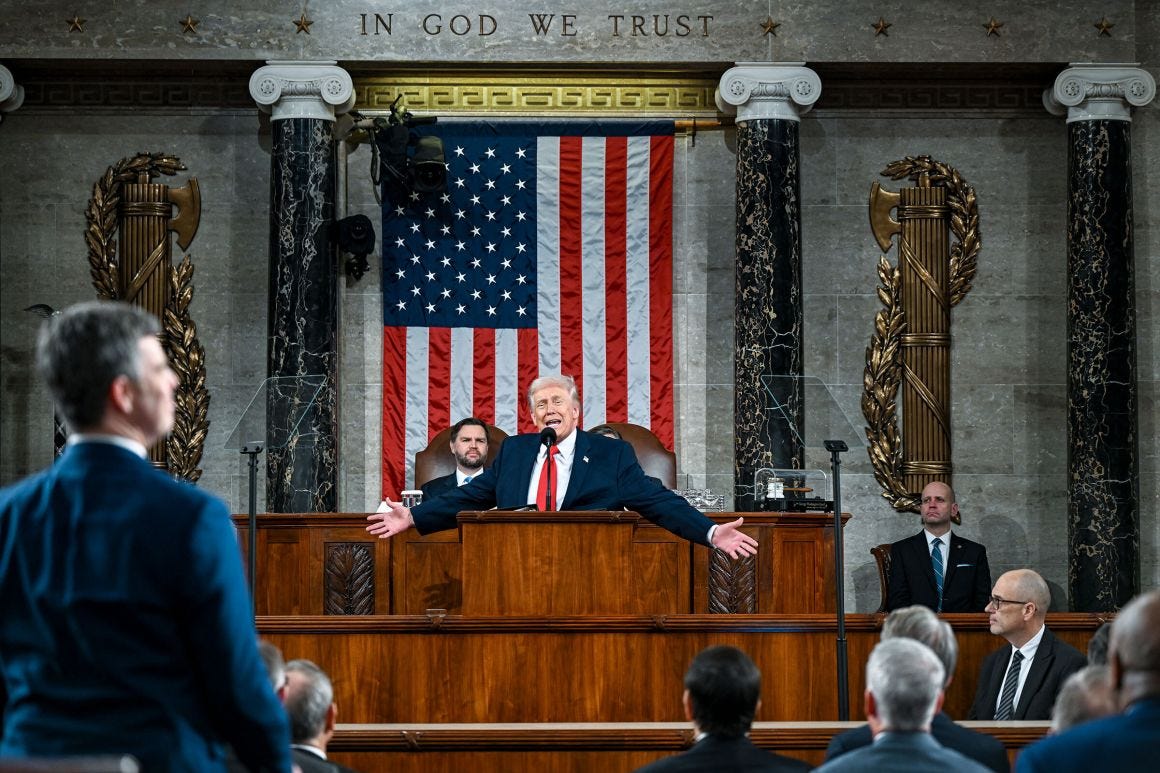
US President Donald Trump delivers his State of the Union address in Washington, DC, on Tuesday, February 24. Trump’s speech clocked in at about an hour and 47 minutes, breaking the record for length set by his address to Congress last year. Photo: Kenny Holston/Pool/Getty Images
The address to Congress was wall-to-wall military symbolism — medals, heroes, even Pete’s Blue Angel. It was everything you could ask for — except what a president is bound to disclose.
By Michael Shaw
Practically speaking, the war went live before the speech was even over. Within four days of Donald Trump’s 2026 State of the Union address, American jets were in the air striking Iran, a mission ordered in secret, without a public case, and without the constitutional consideration and approval the speech is supposed to support.
If you were watching from the House gallery or on television, though, you didn’t see a president leveling with the country about a looming war. You saw a showman surrounded by medals, war heroes, and hand-picked victims, staging a prime-time commercial for American force while burying the real operation off-stage.
That was the organizing lie of this State of the Union: Trump used the night to wrap himself in the symbols and stories of war — its hardware, its sacrifice, its glory — everywhere except where the law and the Constitution actually require it. In the longest presidential address in history — nearly two hours — he mentioned Iran for barely a few minutes and never laid out objectives, risks, or a rationale for what was already in motion.
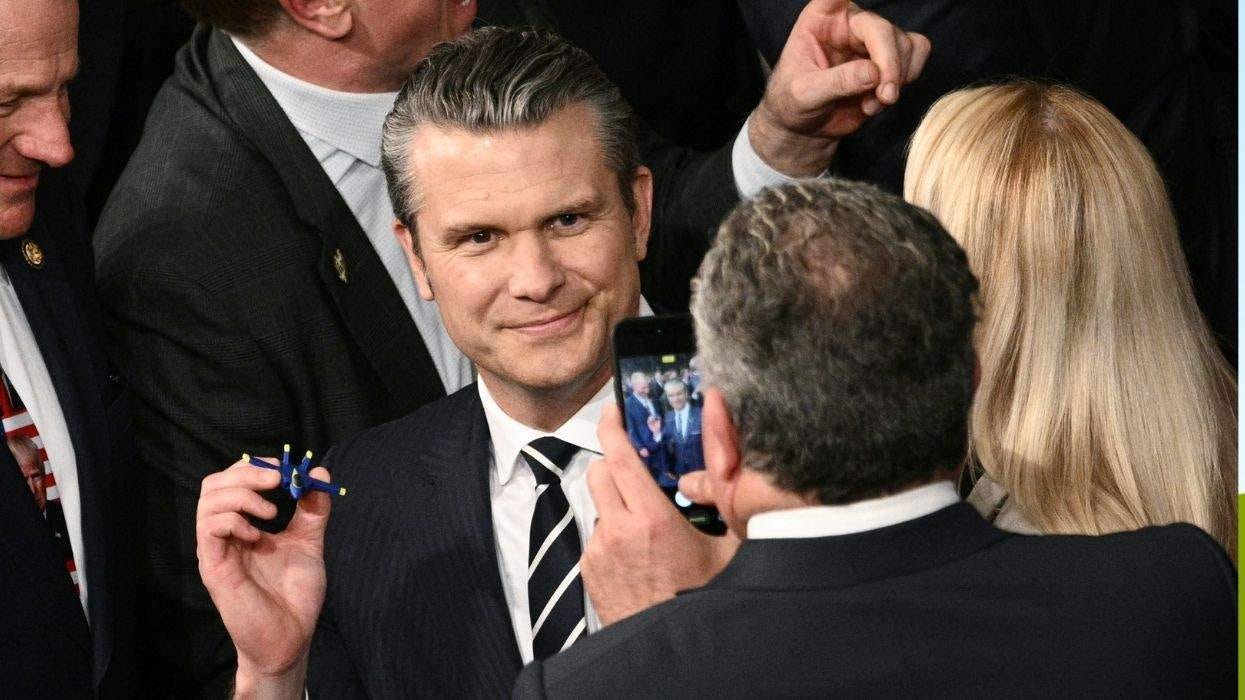
US Secretary of Defense Pete Hegseth holds a model toy of a US Navy Blue Angels F/A-18 Hornet fighter jet as he poses for a picture before the arrival of President Donald Trump for the State of the Union address. Photo: Brendan Smialowski/AFP via Getty Images
But for all of Trump’s dominance that night, the most telling image was Pete Hegseth showing off a toy Blue Angels fighter jet as he entered the chamber. The man in charge of the Pentagon appeared less like a sober guardian of the country’s defenses and more like a kid unable to hide his excitement for the coming firestorm.
General Dan Caine, the Joint Chiefs chairman, was considerably less ebullient. Reporting would later describe him as privately uneasy about the risks of a wider conflict, warning that any move without a clear strategy could spiral into chaos.
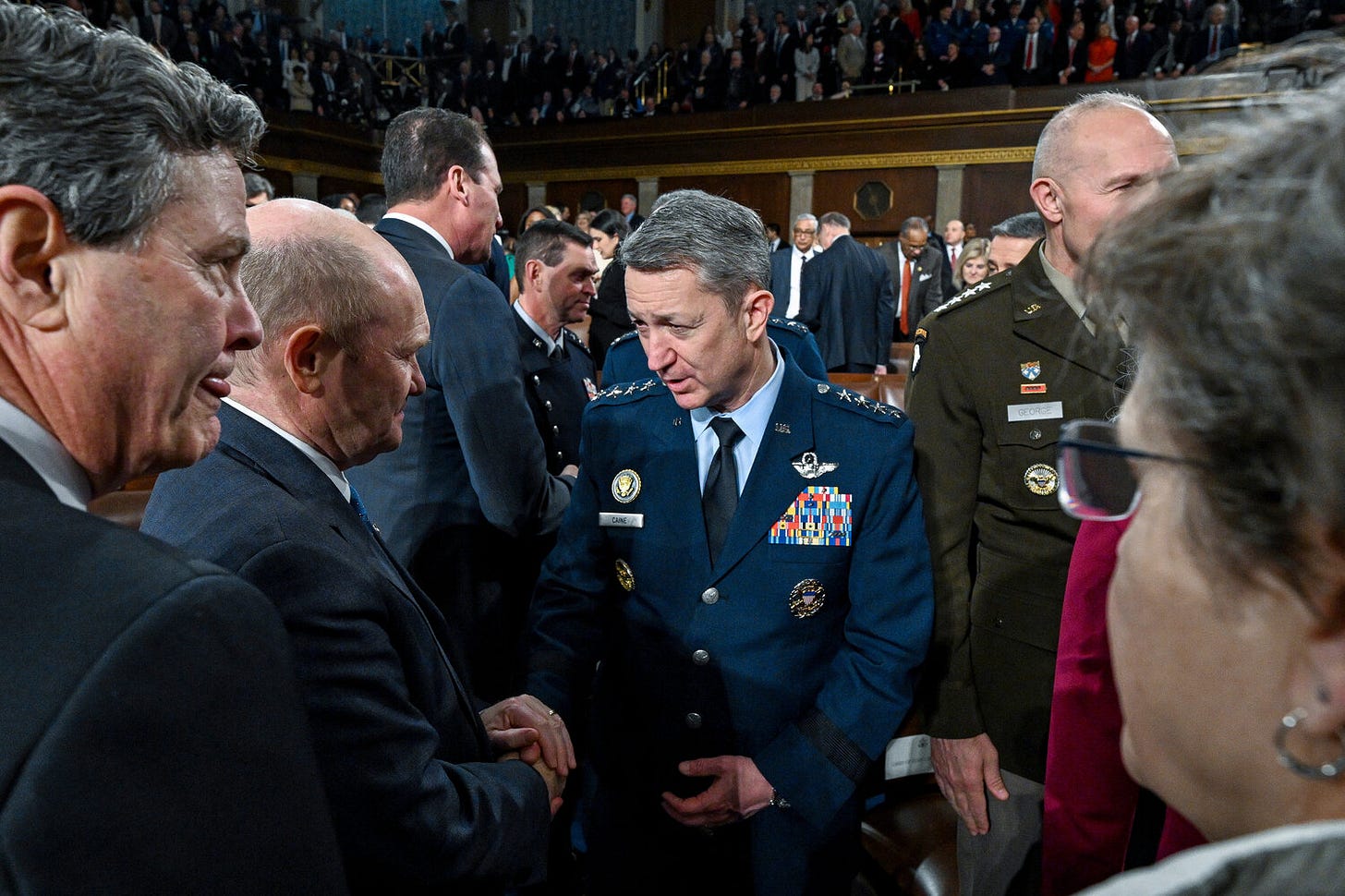
Photo: Kenny Holston-Pool/Getty Images
Here we see Caine and Senator Chris Coons, a ranking member of the Foreign Relations Committee, bent toward each other before the speech began — the photograph now reads less as small talk than as a pre-reckoning. Coons would later call the Iran strike “an illegal war launched without meaningful consultation or consent of Congress.”
Inside the speech itself, war largely appeared as a backdrop for honor and uplift, and the pictures echo the heavy-handed irony. Each image is genuinely moving — and taken together, they turn military service into emotional scaffolding for a conflict the president refused to name.
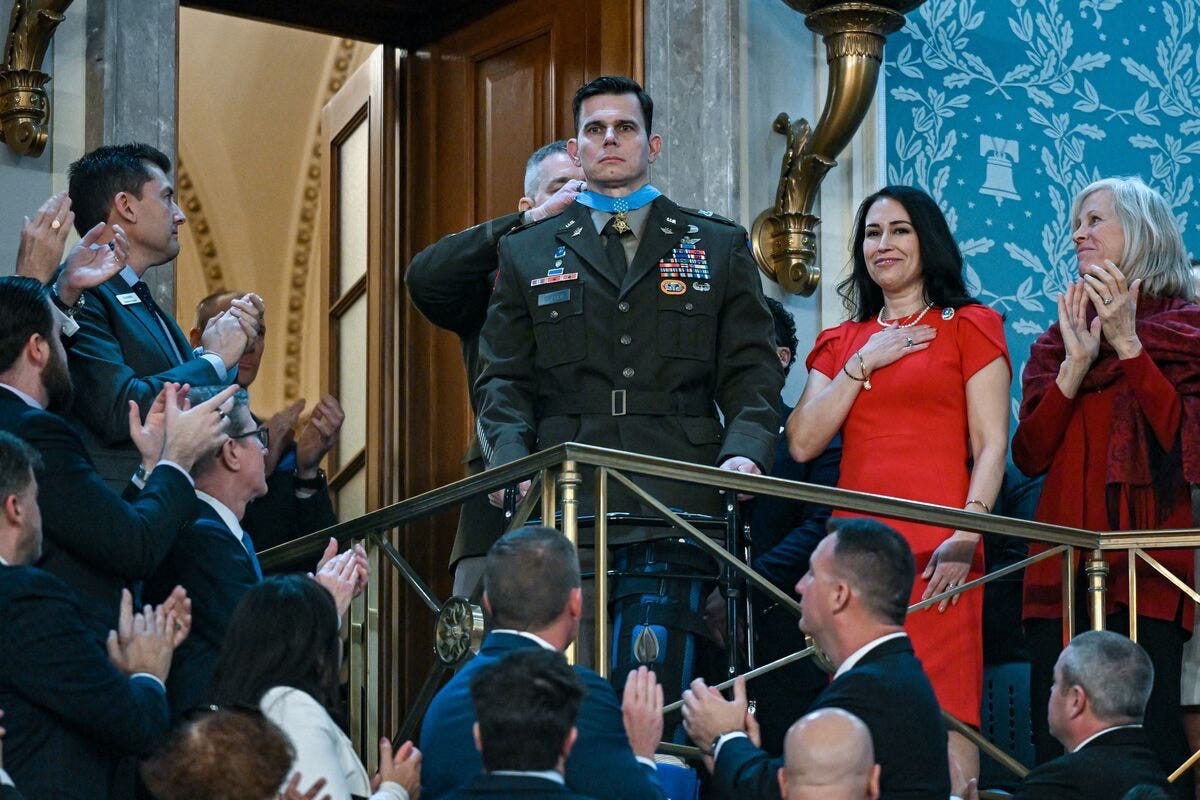
Army Chief Warrant Officer Eric Slover receives a Medal of Honor. Photo: Kenny Holston-Pool/Getty Images
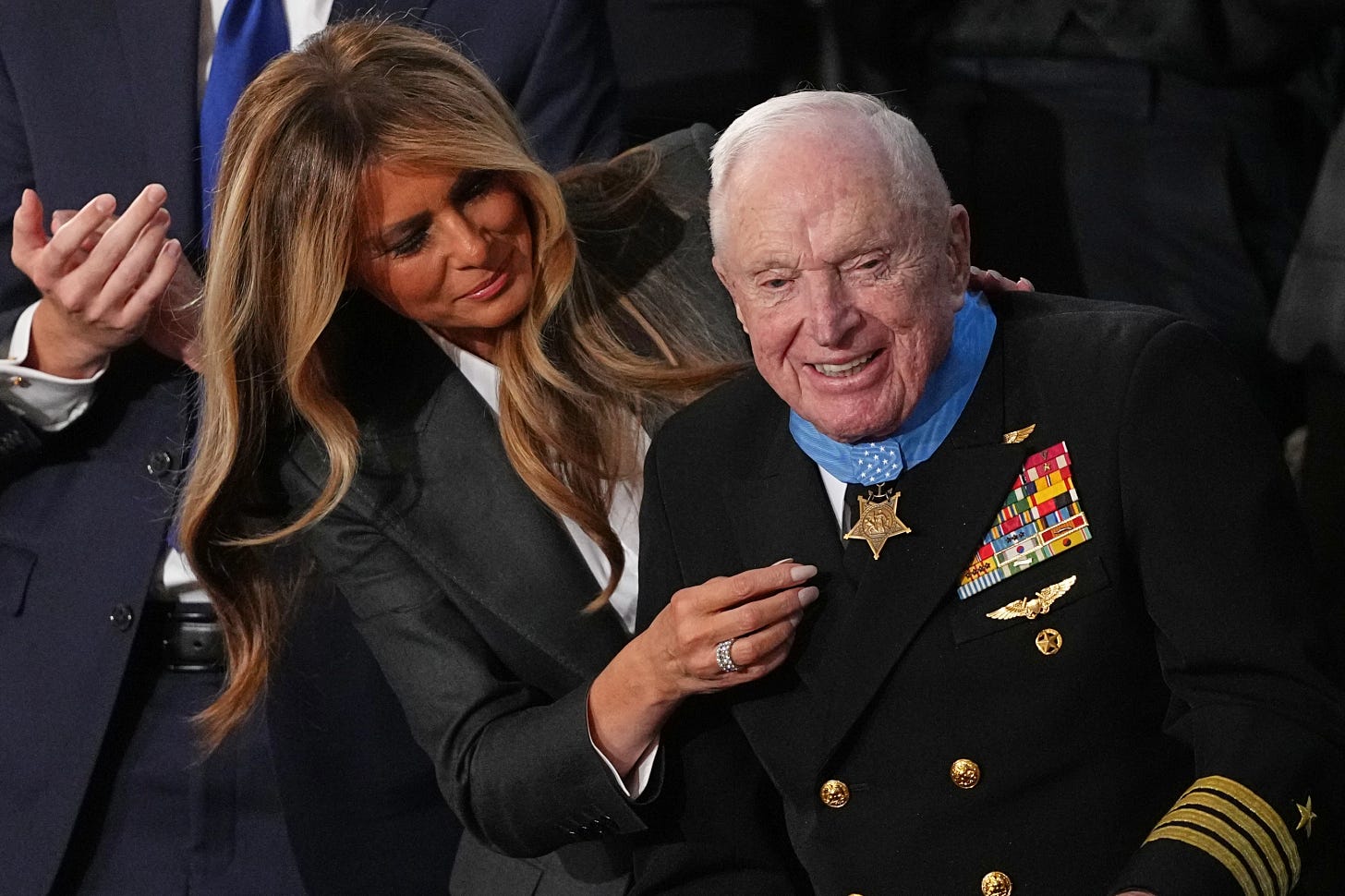
First lady Melania Trump presents the Medal of Honor to WWII Navy pilot Capt. Royce Williams. Photo: AP Photo/Matt Rourke
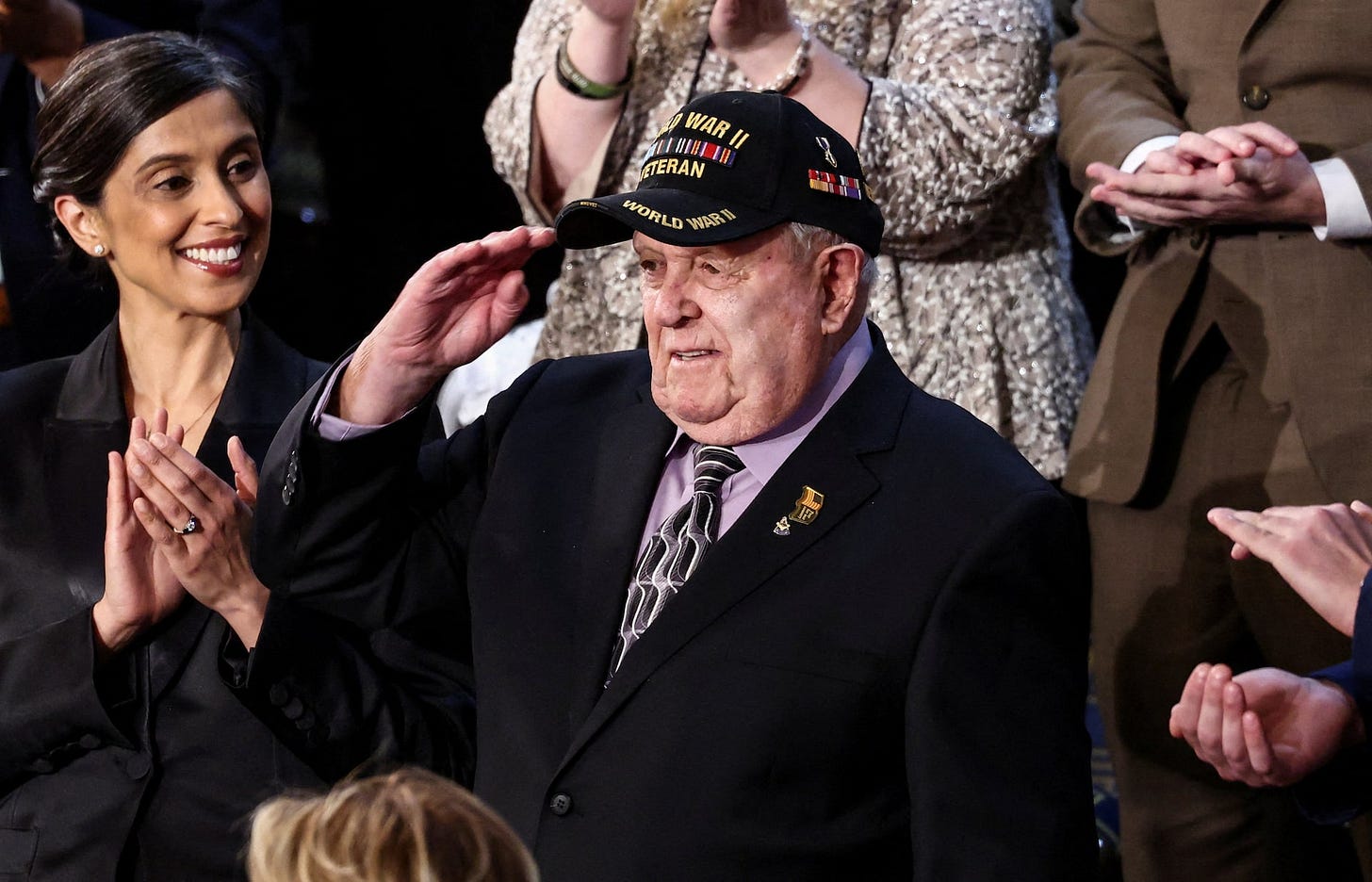
WWII veteran George ‘Buddy’ Taggart salutes. Photo: REUTERS/Kevin Lamarque
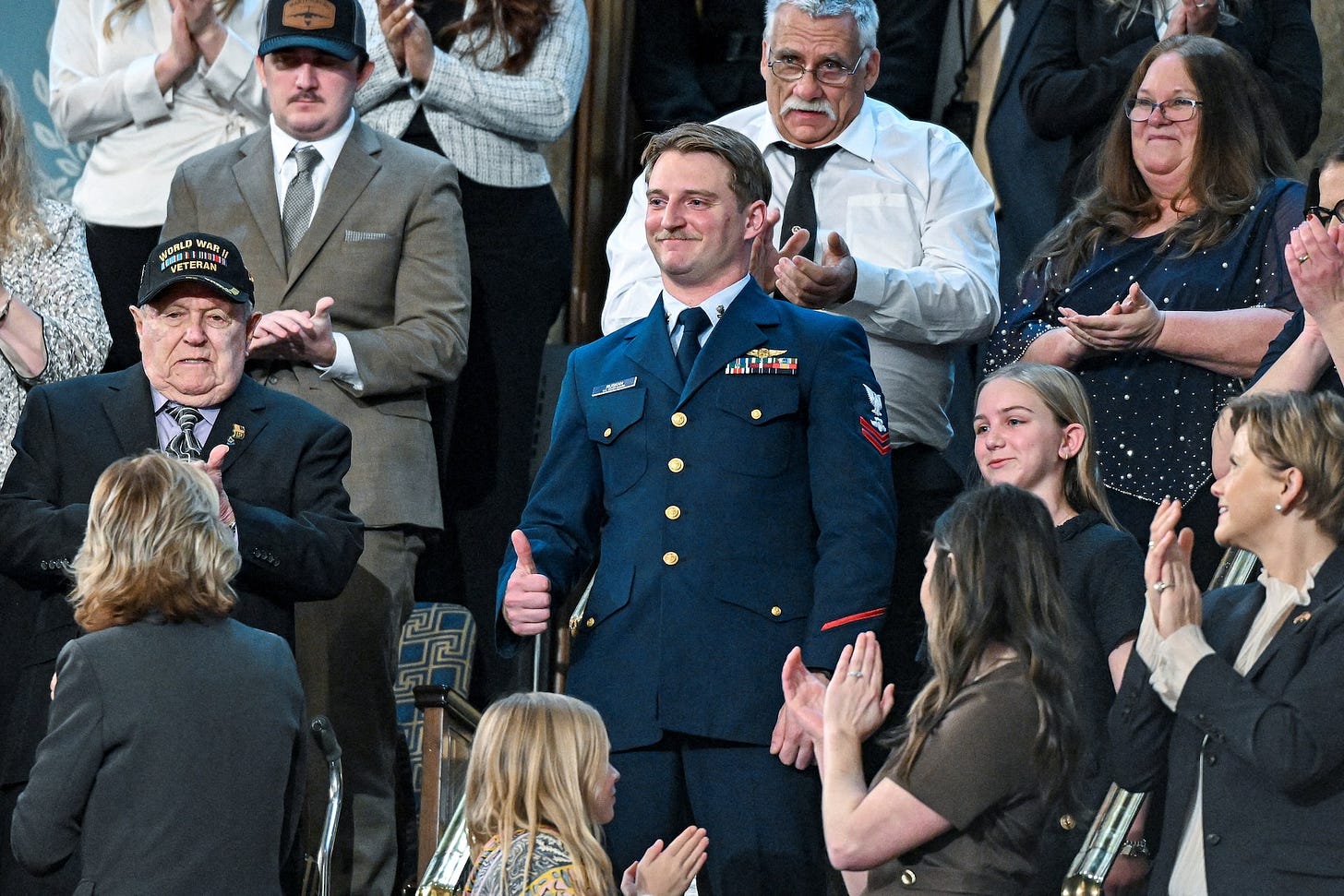
Coast Guard Petty Officer Scott Ruskan. Photo: Kenny Holston/Pool via REUTERS
There was Marine Corporal Kenton Slover, standing at attention as he was praised for his valor; retired Navy pilot Royce Williams, saluted as a living legend from another era; Army veteran Shane Taggart, hand over heart in a tight salute, and Coast Guard Petty Officer, honored for rescuing people from deadly flooding.
But the camera didn’t just linger on the people Trump chooses to honor. It kept finding the people and abuses that his politics have helped to produce. In the same chamber where he wrapped himself in other people’s wars, the images also registered the wars he is waging at home: on women and survivors of sexual abuse, on migrants and their families, on people of color, on dissent itself.
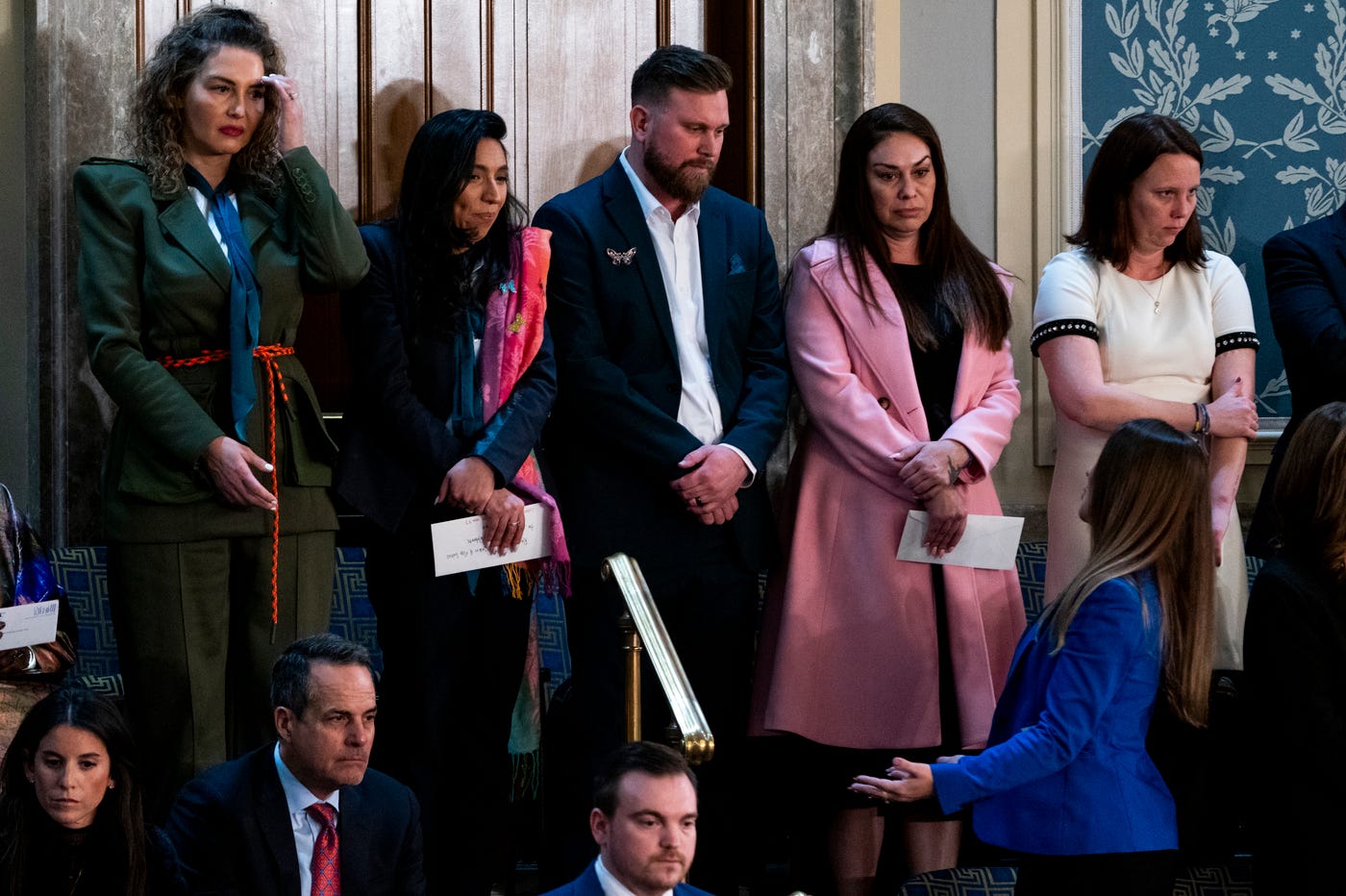
Epstein survivors, including Sky and Amanda Roberts, brother and sister-in-law of the late Virginia Giuffre, attend Trump’s State of the Union address. Photo: Greg Nash/The Hill
The Epstein scandal had been breaking open in the weeks before the speech, with politicians, executives, and public figures around the globe losing their positions as the files and the names kept surfacing. The one place the reckoning had conspicuously stalled was here at home. The survivors in the gallery represent that stall. And within ninety-six hours of the speech, the Iran strikes gave the press and the public something else entirely to fill the zone — one of the more consequential deployments of that trick in the Trump era, given everything else that was buried. The faces in this photograph know exactly how the trick works.
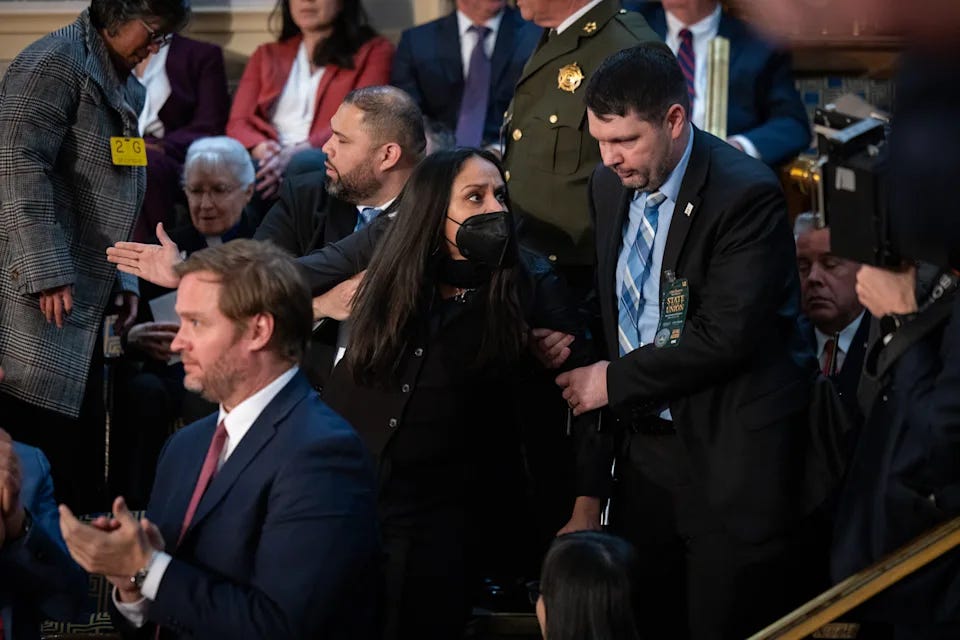
As members stand and turn toward the floor during Trump’s State of the Union, Capitol Police move to remove Aliya Rahman, a guest of Rep. Ilhan Omar, from the House gallery. Photo: Nathan Posner/Anadolu via Getty Images
Aliya Rahman, a guest of Rep. Ilhan Omar, was grabbed and led away by multiple Capitol Police officers after she briefly stood up silently in the gallery — no signs, no chanting — even as people around her were also on their feet and news outlets documented nearby guests standing and applauding while officers focused on her alone. Rahman is an autistic, disabled U.S. citizen with a preexisting traumatic brain injury. In January, ICE agents in Minneapolis had shattered her car window, cut her seatbelt, dragged her from the vehicle, slammed her face down, carried her by her arms and legs, and prevented her from reaching a scheduled brain-injury appointment.
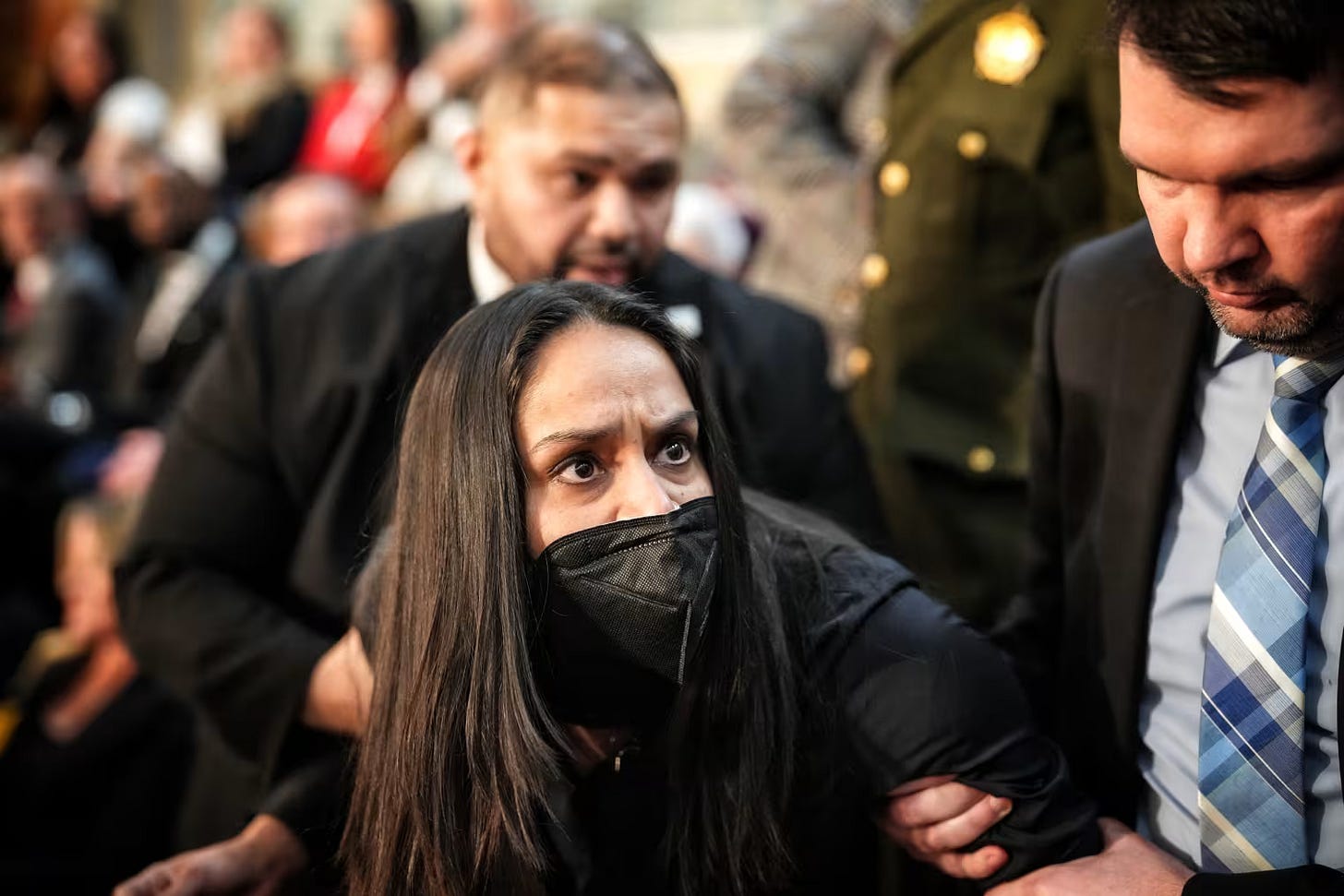
Aliya Rahman is gripped by Capitol Police as she is removed from the gallery. Photo: Frank Thorp V/NBC News
Rahman had warned the officers about her injuries before they hauled her out anyway; she was taken to George Washington University Hospital and later booked.
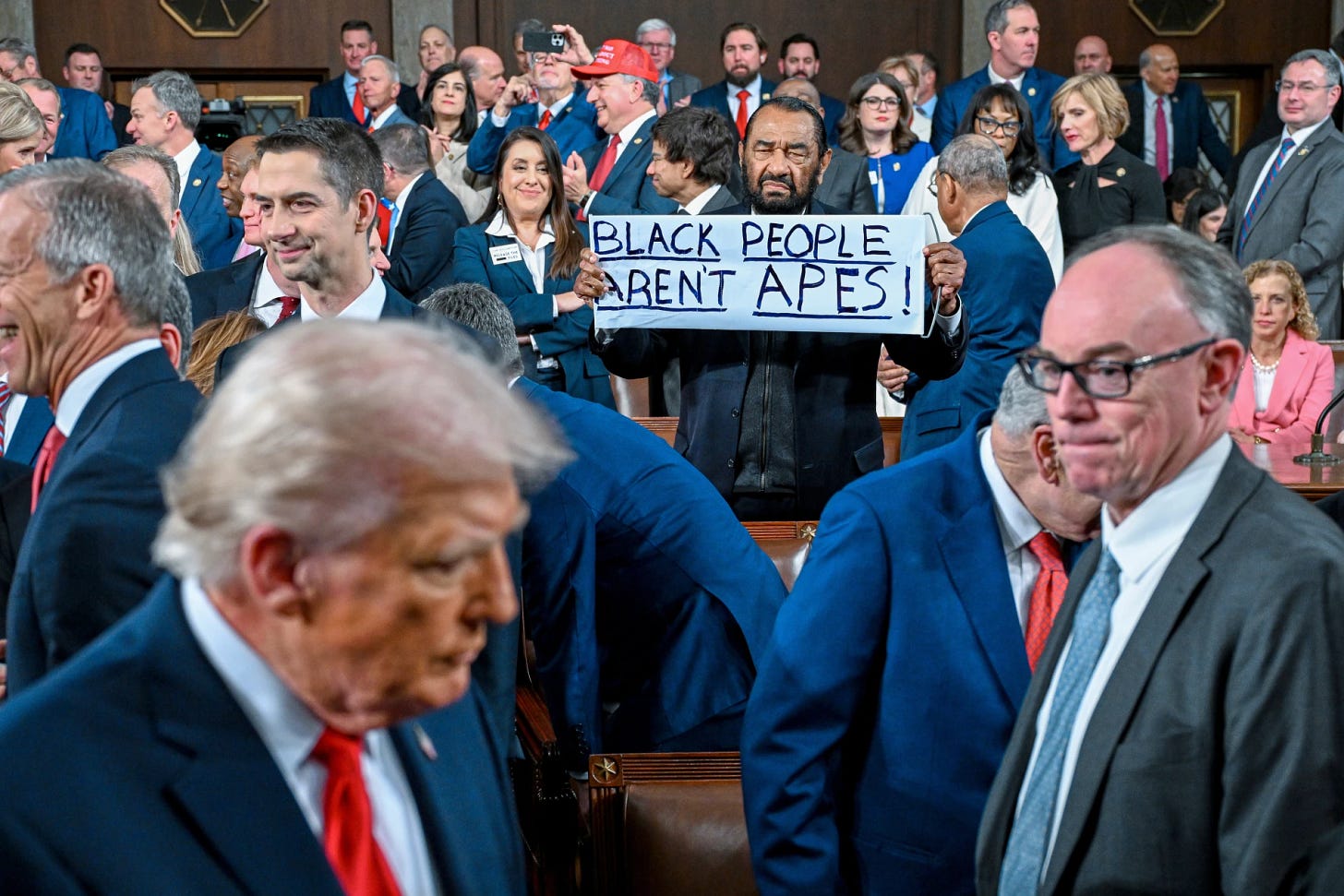
Rep. Al Green, D-Texas, holds up a sign as Trump passes on his way to the lectern. Photo: Kenny Holston/The New York Times via AP Pool
Representative Green was also ejected from the previous year’s SOTU for protesting — and the press and the GOP spent more time amplifying his breach of decorum than the what or the why. The fact that he was largely ignored this time is arguably worse.
This is what erasure actually looks like. Not a confrontation, not a reckoning — just a room so thick with the preferred version of itself that dissent becomes invisible. In any other era, Trump’s racial slur targeting the Obamas — posted on his own social media platform — would have consumed the country. Here, the invisibility of the words on a handwritten sign is nothing if not a testament to the depth of Trump’s authoritarianism and the grip of white nationalism.
What makes the photograph devastating is the compression. Green is literally sandwiched — Trump and his escort in front, a solid bank of white shirts and red ties behind, and to the side. The man directly above him wears a MAGA hat into the chamber, his own act of demonstration, unremarked upon and unpenalized. And on the far right of Green, nearly swallowed by the same crowd, Rep. Debbie Wasserman Schultz, in the pink of the Democratic Women’s Caucus — also barely visible, barely registered.
But what makes the photograph just as cutting is the room’s collective affect — laughter, bonhomie, performative celebration. The levity of the men in their uniform white shirts and red ties, the glee of the pols most accentuated just off Trump’s shoulder — all of it in tension with the deep disaffection on Green’s face and Wasserman Schultz’s, absorbed without a ripple.
The same logic that rendered Green invisible is encoded in the photographs themselves — except in these, it’s made official.
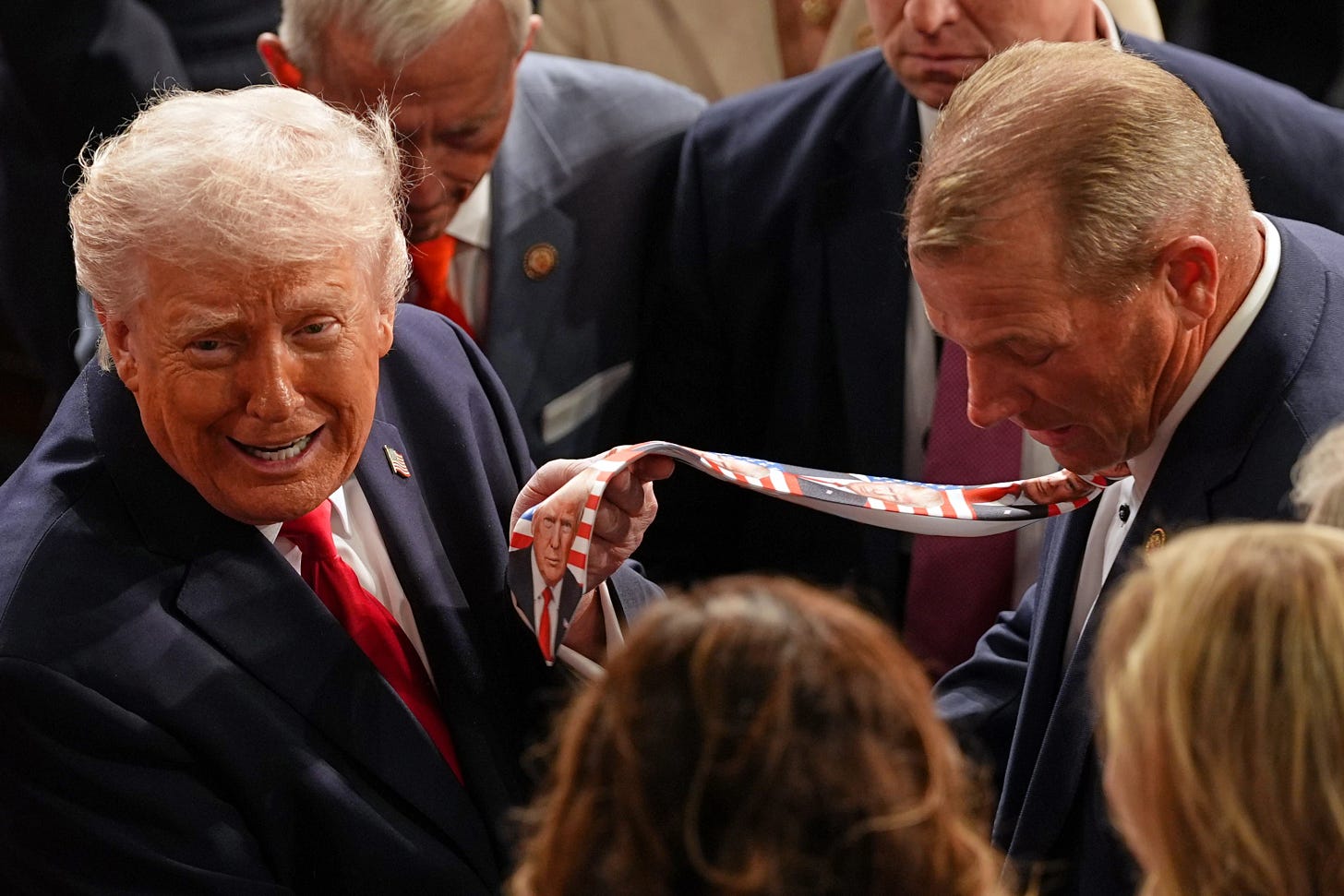
President Donald Trump looks at a tie featuring himself as he arrives to deliver his State of the Union address on Capitol Hill in Washington. Photo: Eric Lee for The New York Times
Rep. Troy Nehls (yes, the same congressman who moments earlier had tried to rip Rep. Green’s banner from his hands) wore a tie printed with portraits of Trump against an American flag — an act of idolatry so complete it doubled as a prop.
The exchange lasted seconds. The appetite it reveals ran through the whole evening.
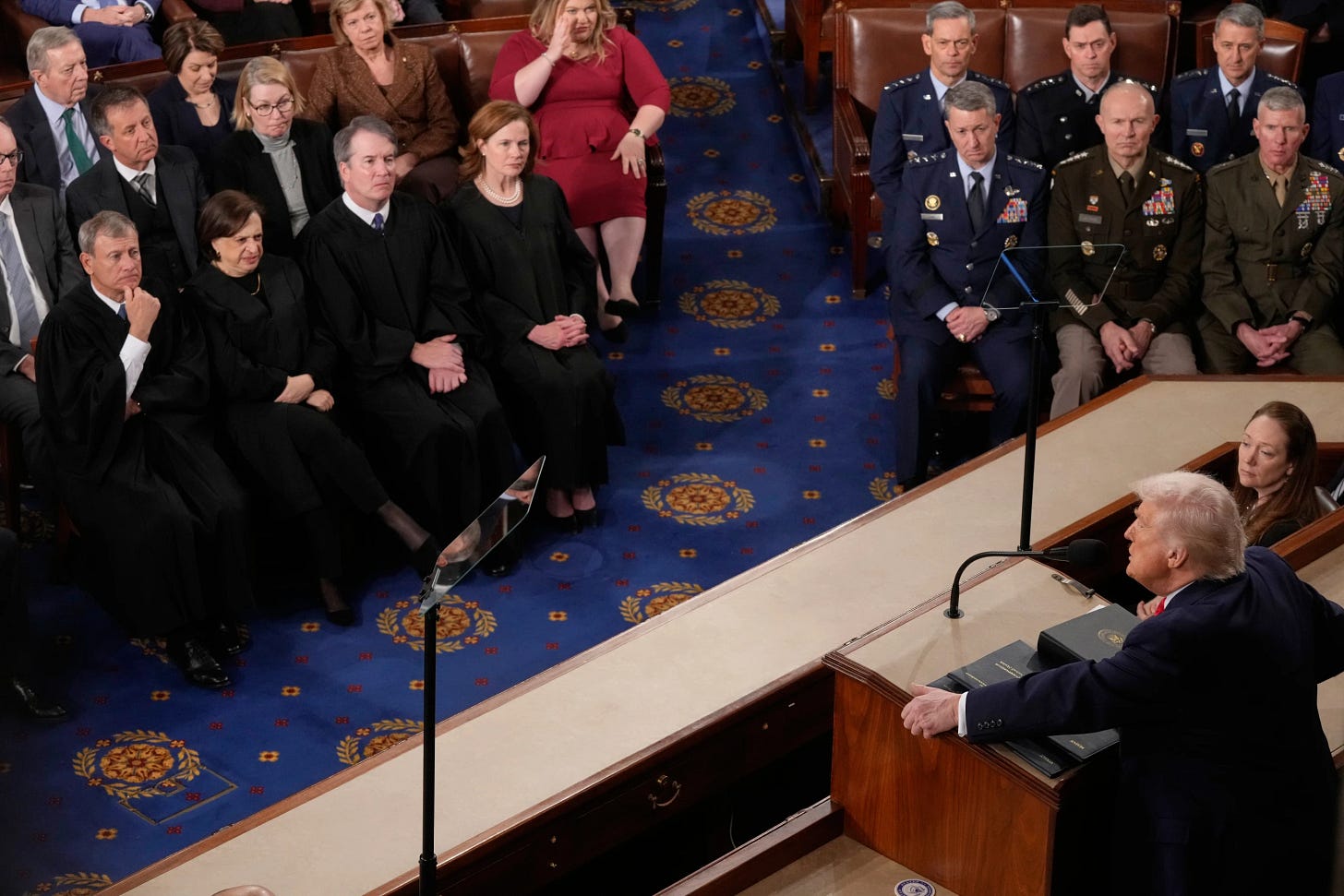
Trump delivers the State of the Union as Supreme Court justices look on. Photo: AP Photo/Mark Schiefelbein
One wire photograph places Trump alongside the Supreme Court justices and the Joint Chiefs — a formal picture that still gestures toward the constitutional order: the judiciary, the legislature, the executive, the military, all in one frame.
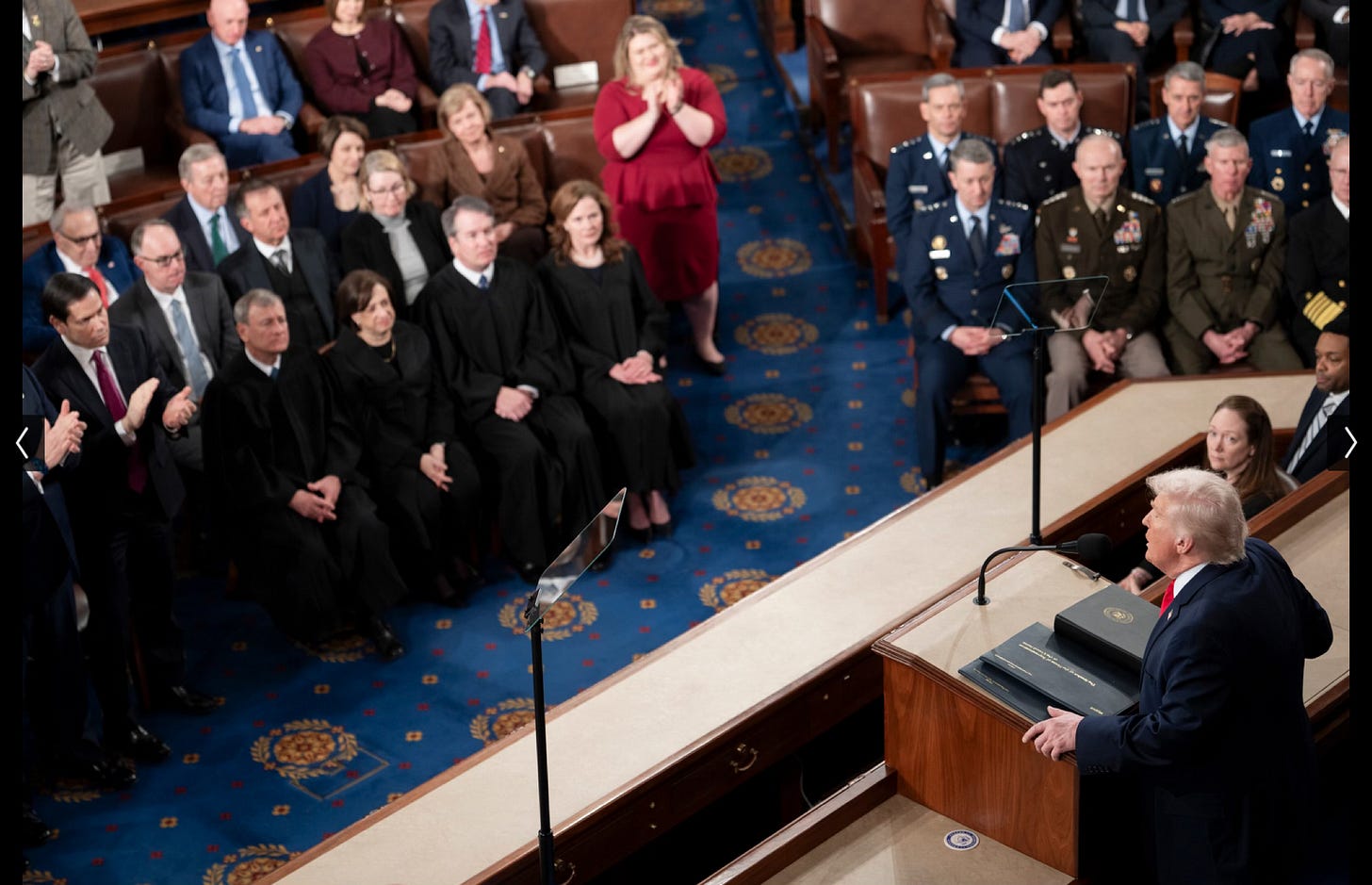
President Donald Trump delivers his State of the Union address, Tuesday, February 24, 2026, on the House floor of the U.S. Capitol in Washington, D.C. Official White House Photo by Andrea Hanks
But the White House released its own version of the same moment, and in that image, Trump is the only figure in sharp focus. The justices, who represent the independent legal check his administration has repeatedly tried to sidestep, are soft shapes at the margins. So are the generals.
That second blur matters on its own terms. Trump and Hegseth showed little patience for the kind of careful, layered military counsel that complicates a clean decision. The blurred Joint Chiefs in the White House photograph are a visual echo of that: the serious concerns, the professional caution, the institutional knowledge that might slow things down — all rendered indistinct, pushed to the edge of the frame where they can confer gravity without interfering with the image Trump wants to project.
That is the organizing logic of the whole evening — and, it turns out, of the Iran attack that followed. Pull the useful symbols forward. Blur whatever complicates the picture. And keep the actual decision, the one that required a declaration and a reckoning with the Constitution, carefully out of focus until the bombs were already in the air.
Follow us on Instagram (@readingthepictures) and Twitter (@readingthepix), and subscribe to our newsletter.
Topic
A curated collection of pieces related to our most-popular subject matter.

Reactions
Comments Powered by Disqus